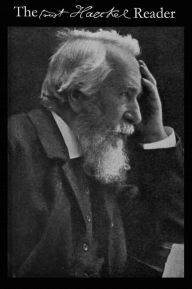
Product Description
CONTENTS: Book I: Evolution in Modern ThoughtBook II: Freedom in Science and TeachingBook III: Monism as Connecting Religion and ScienceBook IV: The Evolution of Man – Volume IBook V: The Evolution of Man – Volume IIHaeckel was a zoologist, an accomplished artist and illustrator, and later a professor of comparative anatomy. Although Haeckel's ideas are important to the history of evolutionary theory, and he was a competent invertebrate anatomist most famous for his work on radiolaria, many speculative concepts that he championed are now considered incorrect. For example, Haeckel described and named hypothetical ancestral microorganisms that have never been found.He was one of the first to consider psychology as a branch of physiology. He also proposed many now ubiquitous terms including phylum, phylogeny, ecology (oekologie) and proposed the kingdom Protista in 1866. His chief interests lay in evolution and life development processes in general, including development of nonrandom form, which culminated in the beautifully illustrated Kunstformen der Natur (Art forms of nature). Haeckel did not support natural selection, rather believing in a Lamarckian inheritance of acquired characteristics (Lamarckism). Haeckel advanced the recapitulation theory which proposed a link between ontogeny (development of form) and phylogeny (evolutionary descent), summed up in the phrase ontogeny recapitulates phylogeny. His concept of recapitulation has been disputed in the form he gave it (now called strong recapitulation). Strong recapitulation hypothesis views ontogeny as repeating forms of the ancestors, while weak recapitulation means that what is repeated (and built upon) is the ancestral embryonic development process. He supported the theory with embryo drawings that have since been shown to be oversimplified and in part inaccurate, and the theory is now considered an oversimplification of quite complicated relationships. Haeckel introduced the concept of heterochrony, which is the change in timing of embryonic development over the course of evolution.Haeckel was a flamboyant figure. He sometimes took great (and non-scientific) leaps from available evidence. For example, at the time that Darwin first published On the Origin of Species by Means of Natural Selection (1859), no remains of human ancestors had yet been found. Haeckel postulated that evidence of human evolution would be found in the Dutch East Indies (now Indonesia), and described these theoretical remains in great detail. He even named the as-of-yet unfound species, Pithecanthropus alalus, and charged his students to go find it. (Richard and Oskar Hertwig were two of Haeckel's many important students.)One student did find the remains: a young Dutchman named Eugene Dubois went to the East Indies and dug up the remains of Java Man, the first human ancestral remains ever found. These remains originally carried Haeckel's Pithecanthropus label, though they were later reclassified as Homo erectus.